 KinPing
If you have been wondering how to check on elderly parents daily without turning into the child who calls too much, you are not alone. Most of us want two things at once. We want to know that Mom or Dad is fine today, and we want them to feel trusted, not watched. Those goals are not in conflict. They just need a little structure.
Why daily contact matters to both sides
For you, a short daily signal takes a vague worry and turns it into a yes or a no. Without it, the mind fills the gap, and you find yourself calling at odd hours or reading too much into a slow reply.
For your parent, a daily signal is a small reminder that someone is thinking of them. It is a bit of routine in a day that can otherwise blur, and a quiet backstop if something does go wrong. Plenty of parents will say they are fine and you should not fuss. Then they quietly enjoy the fact that you asked.
The trick is to make the daily contact so light that it costs neither of you anything.
Choose one question instead of a call
A phone call is a big ask. It needs both people free at the same time, in the mood to talk, and with something to say. On a busy weekday it becomes a chore for you and an interruption for them, and skipped calls feel like failures.
A single question is different. It takes seconds to ask and seconds to answer. Good daily questions are concrete and easy to answer honestly:
- Did you eat?
- Did you take your medicine?
- Are you home safe?
- Did you get out for a walk today?
Pick one. Not five. One question you can both live with for months. Predictability is part of what makes this easy for an older person.
Keep the wording warm and plain. You are a son or daughter, not a shift supervisor.
Pick a time and stick to it
A question that arrives at random feels like an interruption. The same question at the same time every day becomes part of the furniture.
Think about your parent's day, not yours:
- After breakfast works well for "Did you eat?" or "Took your medicine?"
- Early afternoon suits people who like a slow morning.
- Early evening is good for "Home safe?" if they go out during the day.
Avoid very early mornings and late nights. A ping at 7 a.m. feels like an alarm, and one at 10 p.m. can wake a light sleeper and start a worry spiral on both ends.
If you live in a different time zone, set the time by where they are. Your 1:00 PM is not their 1:00 PM.
Respect their independence
What keeps a daily check-in from becoming nagging is that it is a two-way agreement, not a rule you impose.
- Ask them first. Say something like, "I worry a bit when I don't hear from you. Would you be okay with one small question each day? You just reply yes." Framed as helping you, it is an easy yes for many parents.
- Let them choose the question and the time. People follow routines they helped design.
- Accept the short answer. A "yes" is a full answer. Do not follow it up with "Are you sure?" or "What did you eat?" unless they open that door.
- Do not track where they are. A question respects their day. A map watches it, and your parent will know the difference.
- Let them check on you too. Care that flows both ways feels less like supervision, even if it is just "Home safe?" after your commute.
If your parent starts to resist, that is information. Maybe the time is wrong, or the question feels patronizing. Ask what would make it easier rather than pushing harder.
When no answer comes: a calm plan
The point of a daily question is not to panic on the day it goes unanswered. It is to have a calm, pre-agreed plan. Decide the steps now, together, while nothing is wrong.
- Wait a reasonable window. Phones die. People nap. Agree on two or three hours after the usual answer time before you do anything.
- Send a gentle second nudge. A simple "Just checking in" message.
- Call. Their phone first, then the landline if there is one.
- Call someone nearby. A neighbor, a friend, a sibling who lives closer, a building manager, or a regular caregiver. Keep those numbers written down, and make sure those people know they are on your list.
- Call local emergency services. If nobody can reach your parent and you have real reason for concern, call the emergency number for their area and ask for help checking on them.
Write the plan down and share it with your parent and with everyone on it. When the worrying day comes, you will be following a plan instead of improvising.
Be honest about what a daily check-in can and cannot do
A daily question is a well-being habit, not a safety system, and no app is an emergency service. A missed answer may just mean a phone is off, a charger was forgotten, or the question arrived during a long lunch with a friend. Treat silence as a prompt to follow your plan, not as proof that something is wrong.
Equally, a "yes" is not a medical examination. If you notice patterns over weeks, slower answers, more missed days, those are reasons for a longer conversation or a visit, not reasons to add more questions.
A gentler way to ask
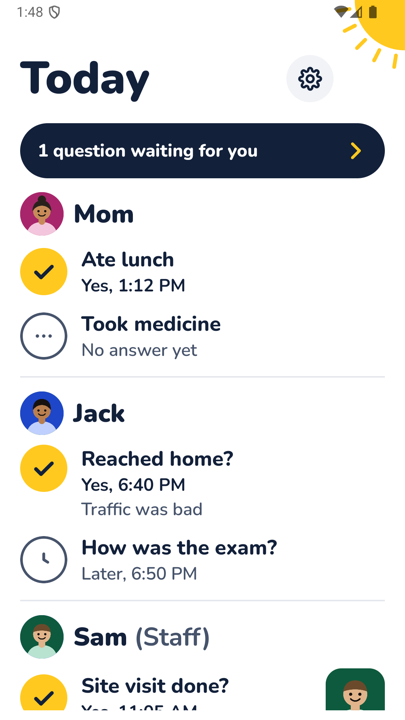
If you want the one-question routine without building it out of reminders and group chats, this is exactly what KinPing is for. It is a family check-in app for people who live apart. You pick one small daily question, like "Did you eat?" or "Took your medicine?", and your parent answers with one tap: Yes, Not yet, or Later. They can add a note or a photo if they feel like it.
There is no GPS tracking, no alarms and no hidden mode. Both of you choose to connect, and your parent approves each question once. A question set for 1:00 PM arrives at 1:00 PM where they are. Your parent does not even need the app to answer; a link in WhatsApp or SMS opens in the browser. Your Today screen shows who has answered and who is still waiting, with up to 14 days of history per person.
It is free, with a small banner ad. Android is in closed testing on Google Play and you can join the Android test. iPhone is coming soon. To say it plainly: KinPing is not an emergency service. A missing answer may just mean a phone is off. Keep your calm plan either way, and in a real worry call your parent, a neighbor or local emergency services. More at how it works and for aging parents.
Updated 2026-11-05.