 KinPing
Every long distance family learns the same lesson eventually. The big video call on Sunday is lovely, and it is not enough. By Wednesday nobody quite knows how anyone is. What keeps a family close across time zones is not the occasional big moment. It is a handful of small, repeatable habits that fit around different clocks and different lives.
Small daily rituals beat big weekly calls
A ritual is something that happens at roughly the same time, in roughly the same way, without anyone having to decide to do it. Decisions are expensive. Rituals are free.
Some rituals that families across time zones find easy to keep:
- The morning photo. One picture of whatever is in front of you when you wake up. The view, the coffee, the dog. No caption needed.
- The one-line day. A single sentence at the end of your day. "Long meeting, good dinner, early night." It takes ten seconds and tells the other person more than a missed call.
- The same question every day. "Did you eat?" "Home safe?" "Took your medicine?" A fixed question is easier to answer than a blank chat window, and the answer is a tiny proof of life.
None of these need both people to be awake at the same time. That is deliberate. Rituals that require simultaneity die the first week the schedules clash.
Time-zone etiquette, written down
Most time-zone friction is about one side forgetting what time it is for the other. A little etiquette, agreed once, saves a lot of small hurts.
- Know each other's quiet hours. Write them down. "Mom: nothing before 8 a.m. or after 9 p.m. her time."
- Send, do not expect. A message sent at your lunchtime may land at their midnight. That is fine, as long as you do not expect a reply before their morning. Silence is usually just sleep.
- Set anything scheduled by their clock. If you want a daily question to arrive after their breakfast, set it for their breakfast, not for a time that happens to be 4 a.m. for them.
- Find the overlap window. Most pairs of time zones have at least one hour that is reasonable for both. Protect it. That is where calls go.
- Say the day as well as the time. "Sunday evening" means two different days across a date line. "Your Sunday evening" is clear.
Keep a note in your phone with each family member's local time. Daylight saving changes do not happen on the same date everywhere.
Photos over calls, most days
Calls are wonderful and exhausting. They need both people free, in the mood, and with the energy to perform a bit. On a normal Tuesday that is a lot to ask.
Photos ask for nothing. A picture of the garden, the grandchild's drawing, the odd thing you saw on the bus. They can be sent at any hour and looked at at any hour. They say "I thought of you" without needing a reply.
- Ordinary over special. A photo of lunch beats a photo of a landmark. Ordinary photos let the other person feel they are in your day, not watching your highlights.
- One a day is plenty. Ten a day becomes noise. One becomes a ritual.
- Reply with a photo, not a paragraph. It keeps the exchange light.
- Let older relatives send too. Many parents are shy about sending pictures. Ask for one specific thing. "Send me a picture of the tomatoes."
Save the calls for the overlap window and for the days when something needs talking about.
Group chat fatigue is real
Many long distance families run on a group chat, and those chats have a way of becoming a problem. A real question from Dad about his hospital appointment scrolls past under a dozen memes. Someone mutes the group, then misses the thing that mattered.
The fix is not a better chat app. It is fewer, clearer channels:
- Keep the group for the group. Jokes, plans, photos for everyone.
- Keep one direct line per person. A quiet thread with just Mom, just your brother. Important things go there.
- Keep one tiny channel for "are you okay." Separate from everything else, so it never gets buried under a forwarded video.
That last one is the piece most families are missing. The daily "are you okay" should be its own small, calm thing that takes one tap and is impossible to miss.
One-tap check-ins
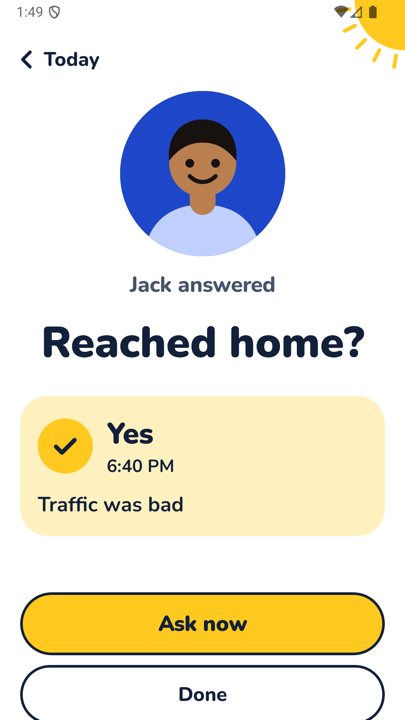
The simplest version of "are you okay" across time zones looks like this. One person sets one small question. It arrives at a fixed time in the other person's time zone. The other person answers with a single tap. The first person can see, at a glance, who has answered today and who is still waiting.
No typing, no deciding what to say. It respects sleep, because it arrives at a sensible local hour, and independence, because a tap is not an interrogation. And it quietly closes the gap between the Sunday calls, because every day has a small signal in it. For a parent living alone, a fixed daily question is also a reminder that someone far away is thinking about them at the same time every day.
Two cautions that apply to any tool you might use for this. First, it is not an emergency service. A missing answer may just mean a phone is off or a nap ran long. Have a plan for the quiet day: a message, then a call, then a neighbor or someone nearby, and in a real worry, local emergency services where they live. Second, check-ins are not tracking. A daily question respects the other person's day. A map of where they are does not, and your parents will know the difference.
A gentler way to ask
If you want a one-tap check-in without building it out of reminders and group chats, this is what KinPing does. It is a family check-in app for people who live apart. You pick one small daily question, "Did you eat?", "Took your medicine?", "Reached home safely?", or write your own, and the person you care about answers with one tap: Yes, Not yet, or Later. They can add a note or a photo if they want to.
A question set for 1:00 PM arrives at 1:00 PM where they are, which is the whole point for a family across time zones. There is no GPS tracking, no alarms and no hidden mode. Both people choose to connect, and the other person approves each question once. Either side can pause or leave. Nobody needs the app to answer; a link in WhatsApp or SMS opens in the browser. The Today screen shows who answered and who is waiting, with up to 14 days of history per person.
It is free with a small banner ad. Android is in closed testing on Google Play and you can join the Android test. iPhone is coming soon. KinPing is not an emergency service, and a missing answer may just mean a phone is off, so keep your own plan for the quiet day. More at how it works and for long distance family.
Updated 2026-11-05.