 KinPing
A daily check-in when you live alone sounds slightly dramatic until you have one, and then it feels like the most normal thing in the world. It is not about being frail or anxious. When you live by yourself, nobody notices if you have a quiet day. A check-in is for the rare day that is not just quiet, and for the peace of mind on all the others.
This routine works at any age, from a student in a first apartment to a widower in his seventies.
Why a check-in, and why daily
When you live alone, a quiet day and a bad day can look the same from the outside. A daily touchpoint means someone would notice the difference by this evening, not whenever they next happen to call.
Daily is the right rhythm because it is hard to drift from. Every other day quietly becomes every third day. Once a day, at the same time, soon becomes automatic, and it is a small moment of connection on a day when you might otherwise not speak to anyone.
Pick a check-in buddy
Your buddy is the person who receives your daily check-in and notices if it does not come. Good buddies tend to be:
- Reliable with their phone. They see messages the same day.
- Calm. A person who follows a plan if you go quiet, not one who panics and calls everyone you know.
- Not exposed to the same risks. If the same storm takes out both your power lines, you cannot help each other much. A sibling in another town, a friend across the country or a parent are all fine.
- Happy to do it. Ask directly. "Would you be my daily check-in person? It is one message a day and a plan for if I ever miss it." People are usually glad to be asked.
Two friends who both live alone can check in on each other, so nobody is the one being looked after.
Pick one time a day
One fixed time is the heart of the routine. Choose it by looking at your real day, not your ideal one.
- Morning suits people with a steady wake-up time.
- Midday is good for people whose mornings vary but who are always around for lunch.
- Evening works for anyone who goes out during the day and wants "Home safe" to be the point.
If your work hours shift, pick the end of the day instead of the start. Set a phone reminder for the first few weeks; after that it sticks on its own. If you are in different time zones, agree the time by your clock, since you are the one who has to answer.
Agree in advance what happens if you miss it
This is the part most people skip, and it is the part that gives the routine its value. Agree on a short ladder with your buddy once, write it down, and both keep a copy.
- The grace period. Two or three hours after your usual time. Phones die, naps happen, meetings run long.
- The nudge. A simple second message. "Hey, did you forget your check-in?"
- The call. They phone you. If you have a landline or a work number, give them both.
- The nearby person. Someone who can knock on your door. A neighbor, a building manager, a friend with a key. Make sure they know they are on the list.
- Emergency services. If nobody can reach you and your buddy has real reason to be concerned, they call local emergency services and ask for help checking on you.
Also agree what you do when you know you will be unreachable. A quick "No check-ins until Sunday" message before a trip saves your buddy worry and saves you a knock on a door you are not behind.
Be honest with each other about the limits. A daily check-in is a habit, and no app is an emergency service. A missed answer may just mean a phone is off. In a real worry, your buddy calls you, then a neighbor, then local emergency services. The ladder exists so that silence leads to calm steps, not to fear.
Keep it light
If every day needs a paragraph, both of you will start dreading it.
- One word is enough. "Yes." "Up." "Home." Done.
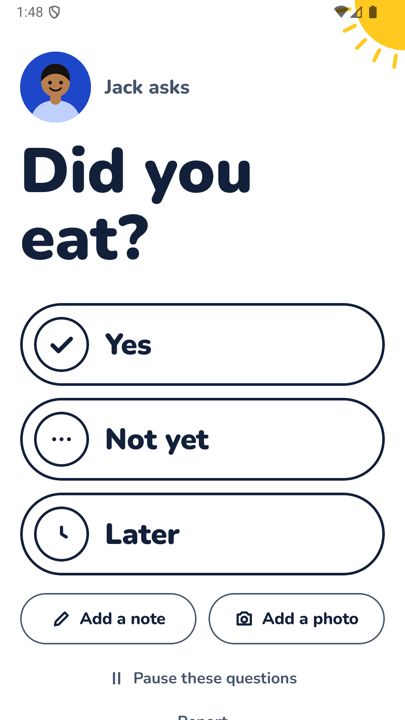
- Make it a question, not a report. "Did you eat?" is easier to answer than a blank status update.
- Add something only when you feel like it. A photo of the sunset, a note about the terrible coffee. Optional, never required.
- Do not apologize for missing one. Answer the nudge and carry on. Guilt makes people quit routines.
If your buddy replies "Are you sure you are okay?" to every one-word answer, remind them that short is fine.
Tools, from a text to an app
You do not need anything special to start.
A plain text message. Zero setup, but nobody is reminded, so after a couple of weeks one side forgets and it fades.
A phone reminder plus a text. Better. Your buddy still has to notice if nothing arrives, which is the hard part on a busy day.
A daily check-in app. The step up when you want the gap to be visible. The ones built for living alone send the question at the agreed time and show your buddy who has answered and who has not. Look for no location tracking, nothing that behaves like an alarm you have to silence every day, and a way to pause when you travel.
The routine matters more than the technology. A text with a good buddy and a written ladder beats a fancy app with nobody on the other end.
A gentler way to ask
If you want the structured version without the heaviness, KinPing was built for exactly this. It is a family check-in app for people who live apart, and it works just as well with a friend. Your buddy asks you one small daily question, "Did you eat?", "Home safe?", or one of your own, and you answer with one tap: Yes, Not yet, or Later. Add a note or a photo if you like.
There is no GPS tracking, no alarms, no "I'm OK" button to forget, and no hidden mode. Both of you choose to connect, you approve each question once, and either side can pause or leave at any time. The question arrives at the set time in your time zone. No app is needed to answer; a link in WhatsApp or SMS opens in the browser. The Today screen shows who has answered and who is still waiting, with up to 14 days of history.
It is free, with a small banner ad. Android is in closed testing on Google Play; you can join the Android test. iPhone is coming soon. KinPing is not an emergency service, and a missing answer may just mean a phone is off, so keep your written ladder with your buddy either way. There is more at how it works and for people living alone.
Updated 2026-11-05.